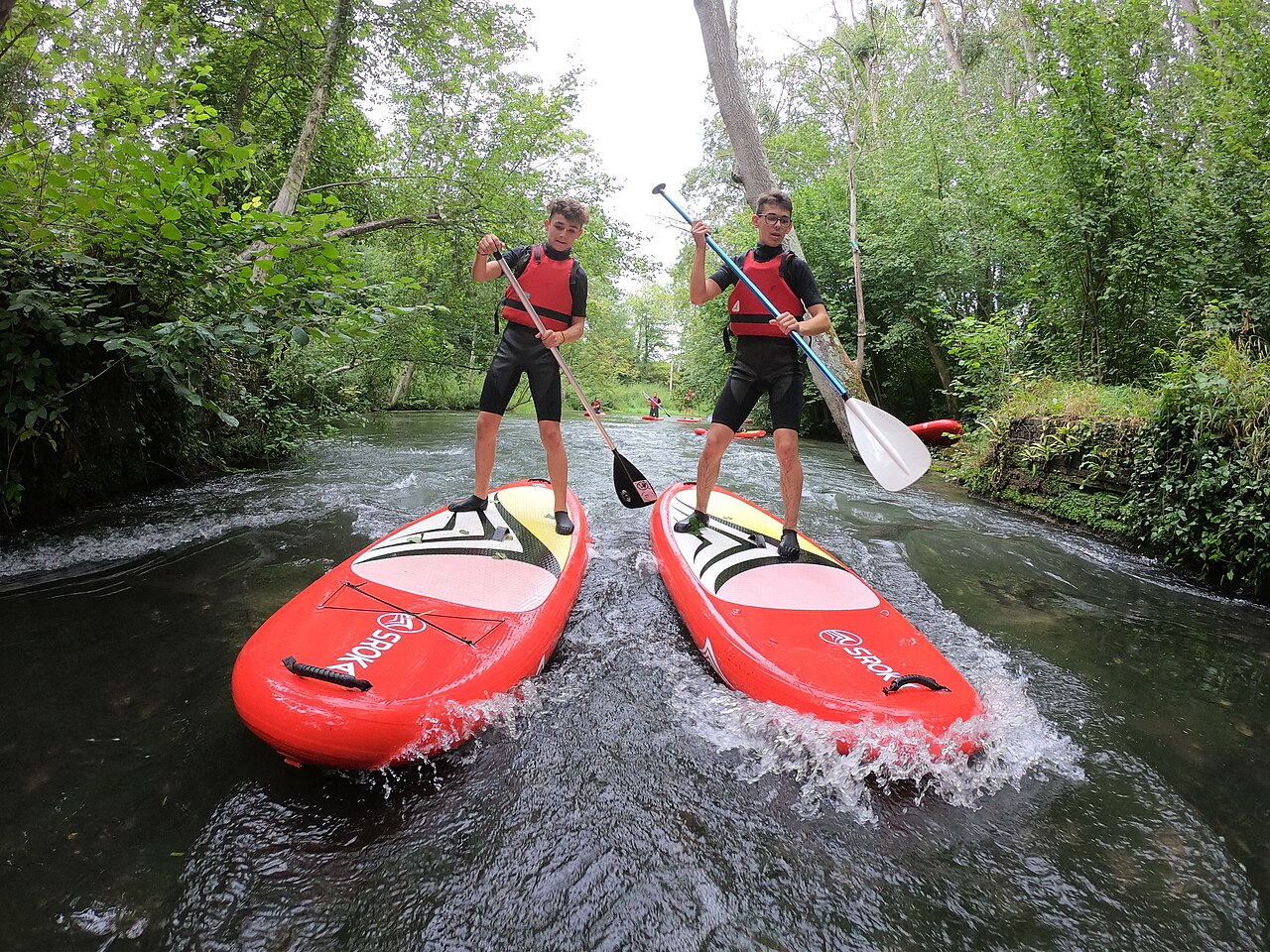
What paddle length should you choose for kayaking or SUP?
A manufacturer’s reference for kayaking and an illustrative SUP calculation: choose a length based on the boat, your height and the type of paddling.

The right length depends on the craft and paddling style. In kayaking, start with your height and the boat’s width; in SUP, your height and intended use. The references below come from Aqua-Bound and help prepare a choice, rather than imposing a universal setting on every brand.
Distinguish kayak and SUP measurements
A kayak paddle has two blades; its overall length is measured from one end to the other. A SUP paddle has a blade and a handle; adjustment changes the distance between them. The same value in centimetres therefore does not describe the same equipment.
Identify the model before applying a chart. For an adjustable paddle, also check its adjustment range and locking mechanism. A readable scale only helps if the assembly is properly secured.
For kayaking, cross-reference height and boat width
Aqua-Bound’s guide provides a chart combining paddler height and kayak width. Example of reading the chart currently linked to the guide: for someone 1.75 m tall and a kayak 75 cm wide, the cell indicates a 230 cm paddle. This reference applies to that manufacturer’s guide and categories, rather than every boat.
Seat height, hull shape and a more vertical or horizontal stroke can lead to adjustments. The same manufacturer has a separate whitewater chart. Do not automatically use a touring paddle length for another discipline.
For SUP, calculate an initial flat-water reference
For recreational flat-water use, Aqua-Bound suggests adding 8 to 10 inches to your height, approximately 20 to 25 cm. Arithmetic example for someone 1.70 m tall: this gives an overall length of approximately 1.90 to 1.95 m. This is a starting point from that manufacturer.
The same guide distinguishes other settings for surfing and racing. Board type, posture and introductory instruction matter: do not treat this calculation as a prescription for every session.
Check the adjustment without forcing the movement
Try the equipment with the team and have the grip, blade orientation and locking mechanism demonstrated. In kayaking, also clarify blade angle where the joint allows adjustment. The aim is to understand what has been set before leaving.
Report it if you regularly hit the boat, have to raise your hands excessively or feel discomfort. Length may be involved, but so may technique or seating: changing several settings alone will not identify the problem.
Compare more than centimetres
For a purchase, note weight, blade size, shaft diameter and detachable parts. When hiring, the aim is equipment adjusted to your session, without assuming that the longest or lightest paddle is always preferable.
An adjustable model allows trials within its permitted range but does not replace technical explanation. Keep a record of the model and setting chosen so you can describe what worked for you.
A method for your next outing
First identify the craft, record its characteristics, consult the paddle guide, then have your position and stroke checked. This gives you an explainable starting length followed by a practical check.
The figure becomes one useful piece of information among others, rather than a formula based solely on your height or a setting found for someone else’s equipment.
Check before booking
- The craft, model and unit of length are identified.
- The manufacturer’s reference matches my use and boat.
- Adjustment and locking are checked with the team.
- Any discomfort is reported so technique and seating can also be checked.
Sources and references
Sources consulted on