Giant SUP: turn a group paddle into a shared holiday outing
One big board makes a group share its rhythm as well as its route. Check capacity, organise the crew and choose a suitable first outing before hiring a giant SUP.
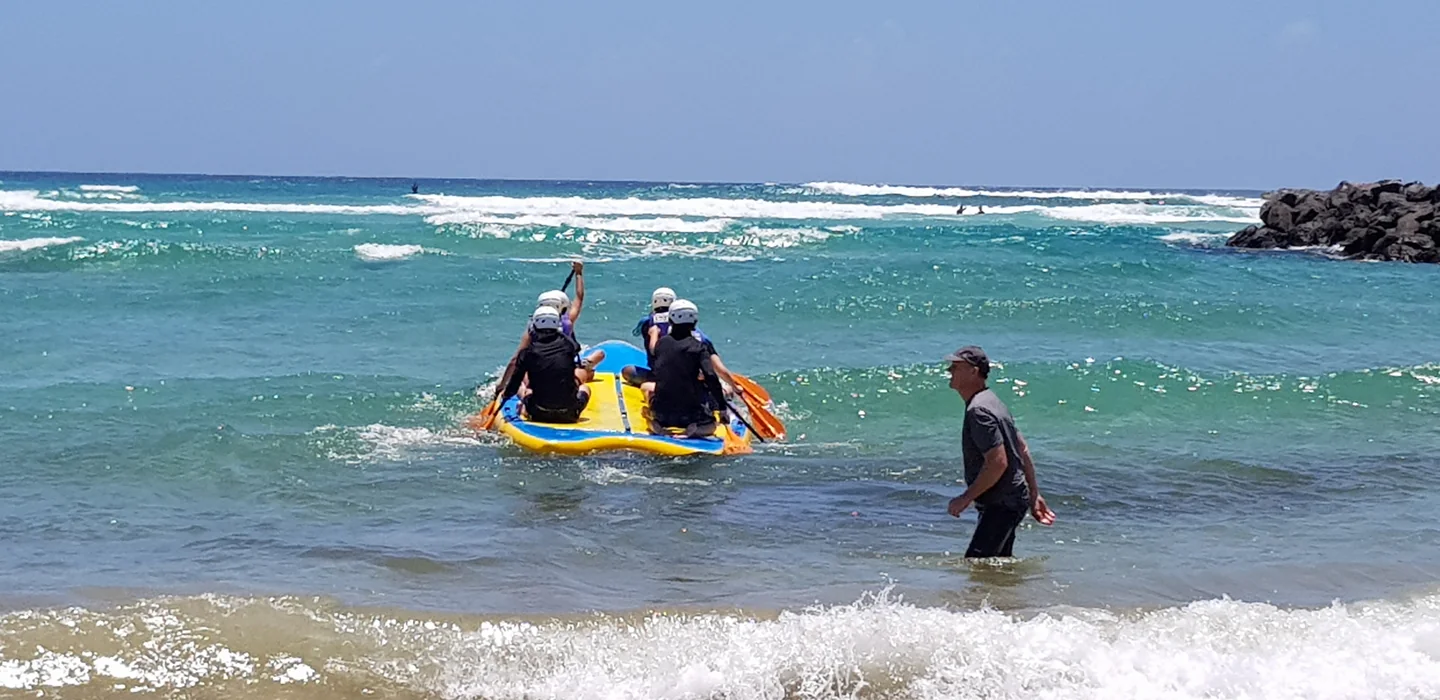
A giant SUP brings the group onto one board and one shared route. Choose the actual model and crew arrangement, then make coordination part of the outing.
One board, one shared rhythm
A giant SUP, also called a big paddle or group paddleboard, is a large board designed for several people to use together. It differs from hiring a set of individual SUPs: everyone shares the movement, route and consequences of an uneven stroke. It is not simply an ordinary board with extra passengers. The permitted crew and total load depend on the exact model and operator. Names such as XL, family and giant describe a range rather than a universal capacity. Establish which board is offered and how the provider assesses your actual group before planning around a photograph of another crew.
The attraction is the shared exercise: agreeing a direction, finding a rhythm and adjusting together. Before departure, choose who gives simple instructions and make sure everyone can hear them. Ask the team how to distribute people and equipment, where to start sitting or kneeling, and how to change position. A group that learns to stop and turn together gains more from the outing than one that immediately chases distance. Agree that anyone can request a pause. If some people want to explore independently or move at very different speeds, separate boards may better match the group's expectations.
A first rental begins on shore
Allow time to move the board with the team's guidance and understand the launch. A large craft can require a coordinated carry and a suitable place to enter the water; do not assume that size makes every departure easier. The briefing should cover paddle handling, the practice area, return arrangements and the procedure if someone leaves the board unexpectedly. Confirm how assistance is requested and whether the session is guided or independent. Practise near the departure area under the operator's instructions before setting a route. The aim is a crew that can manage a simple manoeuvre together, with each person understanding their role.
Published examples to check for your dates
La Base Nautique in Saint-Jean-de-Monts lists big-paddle rental, and its equipment-rental page describes a March-to-November period. Session Gliss in Cavalaire-sur-Mer also lists giant paddleboards. These examples establish that operators publish this type of activity; they do not guarantee an available board, a particular capacity or an appropriate sea state on your dates. Ask each provider about the actual group format and seasonal arrangements. A family label or an individual SUP price elsewhere on the same website may concern a different craft, so make the equipment name explicit when comparing the offer.
Read the conditions as a group
Wind, chop, shorebreak and boat traffic affect a shared board and its launch. Ask which area is suitable for the least experienced participant and when the team would cancel or move the activity. A wide deck does not establish that the outing is appropriate for everyone or all conditions. Keep the first route modest and include the effort of returning. Follow the provider's instructions about flotation equipment and any board connection system, since these depend on the site and craft. Give swimmers and wildlife space, keep clear of sensitive margins and leave belongings ashore unless secure storage has been agreed.
Compare a complete group outing
Ask whether pricing is per board or person, how many paddles are included and whether the briefing counts within the rental period. Clarify participant requirements, combined load, deposit, damage terms and weather changes before collecting contributions from friends. Check practical access and any help needed to carry and recover the board. A short coordinated outing can be a satisfying part of a beach day without becoming a long expedition. Choose giant SUP for a genuinely shared activity and individual boards for greater independence. The useful promise is time together on an appropriately chosen route, with capacity and conditions confirmed for your own crew.
How many people fit on a giant SUP?
There is no universal number. The model, combined load and provider's conditions determine the permitted crew.
Does everyone need to stand?
Ask the operator which positions and progression suit the board and conditions. A photograph is not a boarding instruction.
Is a giant SUP easier than individual boards?
It changes the challenge: crew coordination and shared manoeuvres become central. Suitability depends on the group and conditions.
Check before booking
- Confirm crew size and total load.
- Choose one voice for shared manoeuvres.
- Check help with carrying and launching.
- Ask what the group price includes.
- Match the route to the least experienced person.
Sources and references
Sources consulted on